The phrase “high-scoring subject” sounds useful because it turns a difficult decision into a shortcut. In practice, a subject is valuable only when the combination is valid, the syllabus is manageable, and you can produce the kind of answers its examiners expect.
Start with validity, because preference cannot override the rules
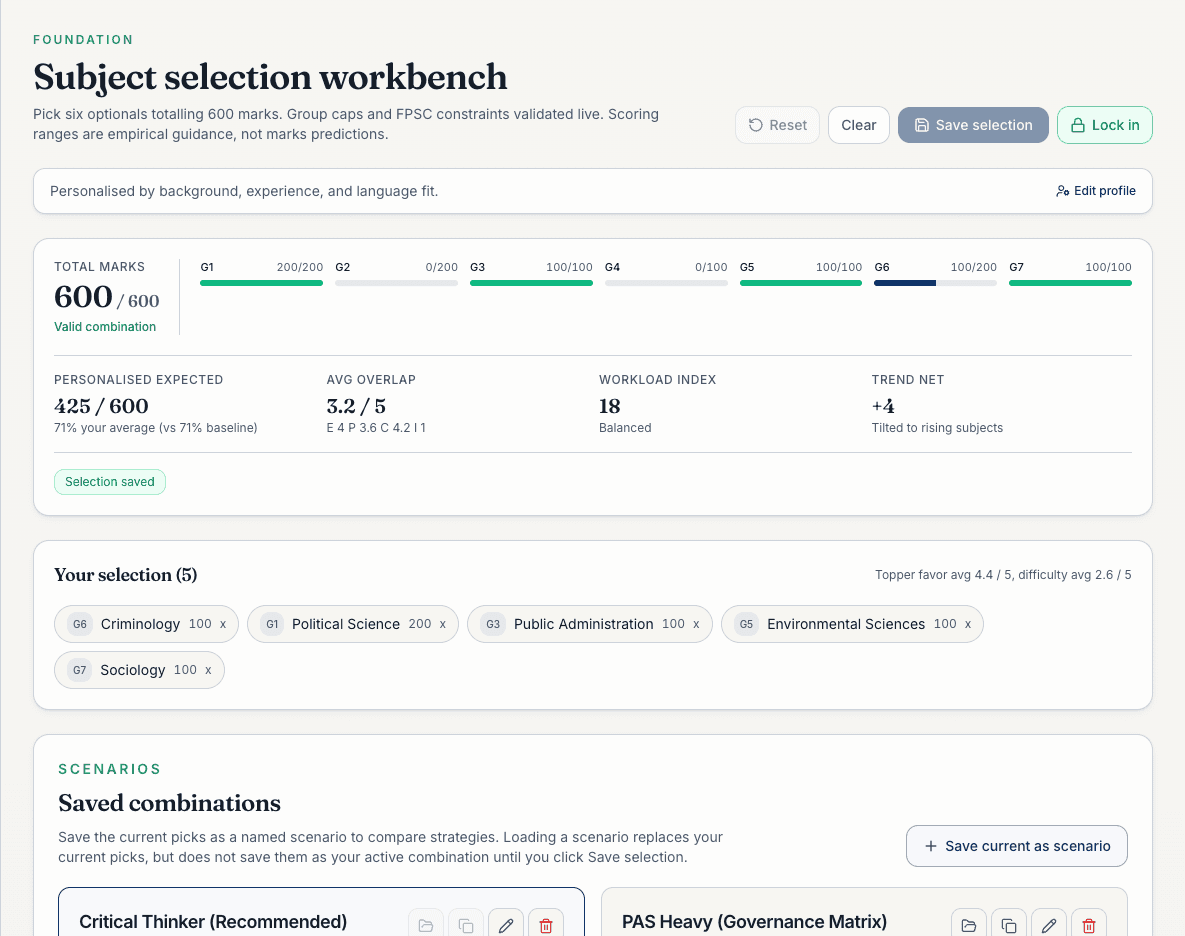
CSS optionals are organised into FPSC groups with limits on how many marks can be selected from each group. Your final combination must total 600 marks. Build inside those constraints from the start instead of creating a favourite list and trying to repair it later.
Use the current FPSC syllabus and rules when saving a combination. Coaching posts and old forms can become outdated, while an invalid selection is not a strategic difference of opinion.
Judge every subject on five factors
No single metric is enough. Overlap may reduce reading but still leave a difficult paper. A compact syllabus may demand unfamiliar theory. A regional language may reward genuine command but punish someone who only speaks it conversationally.
Academic background
How much terminology, theory, or technical method do you already understand?
Answer fit
Can you explain, compare, criticise, and apply the subject under time pressure?
Syllabus volume
How much new material must be covered, revised, and practised before the exam?
Useful overlap
Does the subject strengthen compulsory papers without becoming a duplicate reading burden?
Resource quality
Can you access primary texts, reliable lectures, past papers, and feedback for this subject?
Treat scoring trends as a weak signal
Anecdotes usually overrepresent exceptional scores and recent coaching fashion. They rarely show the full distribution, candidate background, answer quality, or year-to-year examiner differences. That makes them unsuitable as a primary decision metric.
Trends can be used as a question to investigate: why do prepared candidates report doing well or badly? The answer may reveal a compact syllabus, objective components, demanding technical expectations, or widespread generic preparation. But the label itself does not predict your marks.
Run a two-hour test before committing
Choose one central syllabus topic from a shortlisted subject. Spend 45 minutes learning it from a reliable source, 30 minutes reviewing related past-paper questions, and 45 minutes writing an outline or short answer without notes.
Then check whether you could define the core concept, use relevant evidence, handle a critical command such as analyse or evaluate, and finish within time. Repeat this for the final two or three candidates. The result is more personal and useful than a popularity table.
Balance the complete 600 marks, not each subject in isolation
A combination should distribute risk and workload. Several theory-heavy subjects may create useful overlap but also produce the same reading and writing bottleneck. Several technical subjects may offer objective marking but demand long problem-solving practice.
Check the final combination for total syllabus volume, language demand, diagram or numerical practice, availability of feedback, and overlap with compulsory papers. The best combination is the one you can revise repeatedly and answer convincingly, not the one with the most attractive individual labels.
Write down why every subject belongs
For each selected subject, record one sentence for background fit, one for overlap, one for the main risk, and one for how you will practise answers. Revisit this after two weeks of real study.
If the decision still depends mainly on “people say it scores,” the subject has not passed the test yet.
The practical takeaway
Choose each optional only after testing one syllabus topic and one past-paper question. A subject you can explain analytically is safer than one recommended only by a trend list.